
Introduction
If you run a business in India, you’ve probably heard your accountant say, “Your GST numbers don’t match.” That mismatch is more common than you think, and it can lead to blocked Input Tax Credit (ITC), notices from the GST department, or unnecessary penalties.
This is exactly where GST reconciliation comes in. Whether you are a business owner, a Chartered Accountant, a bookkeeper, or an eCommerce seller juggling multiple marketplaces, understanding how GST reconciliation works is no longer optional — it’s essential for staying compliant and protecting your cash flow.
In this guide, we’ll break down GST reconciliation in simple, practical terms. You’ll learn what it actually means, why it matters, the exact step-by-step process, the documents you need, common mistakes to avoid, and how automation tools like Narti Solutions can save your team dozens of hours every month — especially if you sell on Amazon, Flipkart, Meesho, Myntra, or Shopify.
By the end of this article, you’ll have a clear, actionable understanding of GST reconciliation that you can apply to your own business, whether you’re filing for the first time or managing reconciliation for multiple clients.
What Is GST Reconciliation?
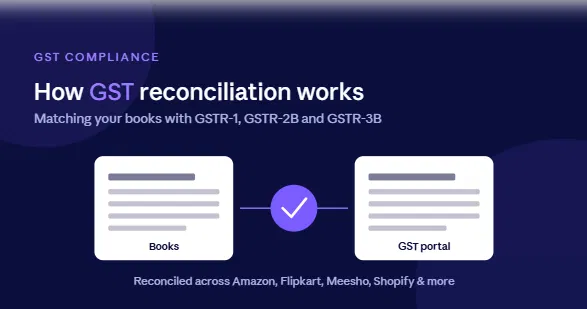
GST reconciliation is the process of matching the data recorded in your books of accounts with the data available on the GST portal (GSTN). In simple words, it means comparing two sets of records to check if they say the same thing.
There are mainly three records involved:
- Sales/Purchase data in your accounting books (Tally, Busy, Zoho Books, Excel, etc.)
- GSTR-1 — the return where you report your outward supplies (sales)
- GSTR-2B/2A — auto-generated statements showing the Input Tax Credit (ITC) available based on what your suppliers have reported
- GSTR-3B — the summary return where tax is actually paid
When all these records align, your GST filing is accurate. When they don’t, you get mismatches — and mismatches are the number one reason businesses lose ITC or receive compliance notices from the GST department.
Featured Snippet Answer: GST reconciliation is the process of comparing sales, purchase, and tax data recorded in a business’s accounting books with the data reported on the GST portal (GSTR-1, GSTR-2A/2B, and GSTR-3B) to identify and correct mismatches before filing returns.
Why GST Reconciliation Matters for Your Business
Many small business owners treat GST reconciliation as a “year-end formality.” That’s a costly mistake. Here’s why reconciliation deserves monthly attention:
- Protects Input Tax Credit (ITC): If your purchase records don’t match your supplier’s GSTR-1 filing, the GST portal may not reflect your ITC, meaning you pay more tax than necessary.
- Avoids GST notices: Mismatches between GSTR-1, GSTR-3B, and books are a common trigger for departmental scrutiny.
- Improves cash flow: Accurate reconciliation means you claim every rupee of ITC you’re entitled to, reducing your tax outflow.
- Builds audit readiness: Clean, reconciled books make annual GST audits and assessments far less stressful.
- Supports accurate financial reporting: Reconciled data gives business owners a true picture of sales, returns, and tax liability.
For eCommerce sellers specifically, reconciliation becomes even more critical because marketplaces deduct commissions, TCS (Tax Collected at Source), and other charges before settling payments — and these need to match GST records too.
Types of GST Reconciliation
GST reconciliation isn’t a single activity. Depending on your business model, you may need to perform several types:
1. GSTR-1 vs GSTR-3B Reconciliation
Checks if the outward supply (sales) reported in GSTR-1 matches the tax paid in GSTR-3B.
2. GSTR-2A/2B vs Purchase Register Reconciliation
Matches the ITC reflected by your suppliers against what’s recorded in your purchase books.
3. Books vs GST Portal Reconciliation
Compares your internal accounting records (Tally, Zoho Books, Busy) with what’s actually filed on the GST portal.
4. E-Way Bill Reconciliation
Ensures goods movement recorded in e-way bills matches invoice and sales data.
5. Marketplace Settlement Reconciliation (for eCommerce sellers)
Matches sales reported by Amazon, Flipkart, Meesho, and other platforms against GST returns and actual bank settlements.
How Does GST Reconciliation Work? (Step-by-Step Process)
Here is the practical, step-by-step process most businesses and accountants follow:
Step 1: Gather All Source Data
Collect your sales register, purchase register, GSTR-1, GSTR-2A/2B, GSTR-3B, and bank statements for the relevant period.
Step 2: Download GSTR-2A/2B from the GST Portal
Log in to the GST Portal and download the auto-populated GSTR-2A and GSTR-2B reports for the tax period.
Step 3: Match Purchase Invoices with GSTR-2A/2B
Compare each invoice in your purchase register against what suppliers have uploaded. Flag invoices that are missing, have a mismatched amount, or show a different GSTIN.
Step 4: Reconcile Sales Data with GSTR-1
Cross-check your sales register against the GSTR-1 filed for that period to ensure every invoice has been correctly reported.
Step 5: Compare GSTR-1 and GSTR-3B
Verify that the total outward supply value and tax liability in GSTR-1 matches what was declared and paid in GSTR-3B.
Step 6: Identify and Categorize Mismatches
Common mismatch categories include:
- Missing invoices
- Duplicate entries
- Wrong GSTIN
- Rate mismatch (e.g., 12% vs 18%)
- Amount mismatch
Step 7: Follow Up with Vendors (If Needed)
If a supplier hasn’t uploaded an invoice, you may need to contact them and request correction in their next GSTR-1 filing.
Step 8: Make Corrections in Books or Returns
Adjust your books, or report corrections in the next available GST return cycle, as per GST law.
Step 9: Reconcile Bank Settlements (For eCommerce Sellers)
Match marketplace settlement reports with bank credits and GST sales data to confirm everything ties out.
Step 10: Maintain Documentation for Audit Trail
Keep reconciliation worksheets, correspondence with vendors, and correction records safely for future reference.
Key Documents Needed for GST Reconciliation
| Document | Purpose |
|---|---|
| Sales Register | Internal record of all outward supplies |
| Purchase Register | Internal record of all inward supplies/purchases |
| GSTR-1 | Filed return showing outward supplies |
| GSTR-2A | Auto-populated ITC statement (dynamic) |
| GSTR-2B | Static monthly ITC statement |
| GSTR-3B | Summary return with tax payment |
| Bank Statements | To verify actual payment/settlement |
| E-Way Bills | To verify movement of goods |
| Marketplace Settlement Reports | For eCommerce sellers, to match sales and deductions |
GST Reconciliation for eCommerce Sellers: A Special Case
If you sell on Amazon, Flipkart, Meesho, Myntra, AJIO, Shopify, or JioMart, your reconciliation process is more complex than a typical business because of multiple data layers:
- TCS deducted by marketplaces under Section 52 of the CGST Act must match your GSTR-8 and GSTR-2A/2B.
- Returns and refunds reduce taxable sales but are often reported with a time lag by marketplaces.
- Commission and platform fees are deducted before settlement, which can confuse manual reconciliation if not handled correctly.
- Multiple GSTINs (if you operate from more than one state) need separate reconciliation for each registration.
Without automation, eCommerce sellers often spend 15–25 hours every month manually downloading reports from each marketplace and reconciling them in Excel. This is precisely the gap that platforms like Narti Solutions are built to close — by importing marketplace reports automatically and preparing GST-ready, accounting-ready data in a fraction of the time.
Manual vs Automated GST Reconciliation
| Factor | Manual Reconciliation | Automated Reconciliation (e.g., Narti Solutions) |
|---|---|---|
| Time Required | High (days per month) | Low (minutes to hours) |
| Error Risk | High (human errors, Excel formulas) | Low (system-matched data) |
| Multi-marketplace Support | Difficult, separate downloads needed | Centralized dashboard for all marketplaces |
| GST-Ready Output | Requires manual formatting | Ready-to-export, GST-aligned reports |
| Scalability | Hard to scale with order volume | Easily scales with business growth |
| Accounting Software Export | Manual data entry into Tally/Busy/Zoho | One-click export to Tally, Busy, Zoho Books |
| Audit Trail | Often incomplete | Maintained automatically |
| Best Suited For | Very small businesses with few invoices | Growing businesses, CAs, eCommerce sellers |
Common Mistakes Businesses Make During GST Reconciliation
- Reconciling only once a year instead of monthly, which lets small errors snowball.
- Ignoring GSTR-2B in favor of GSTR-2A, even though GSTR-2B is the static reference for ITC claims.
- Not following up with vendors on missing invoices until it’s too late to correct.
- Manually copying data into Excel, which introduces formula and entry errors.
- Overlooking marketplace TCS mismatches for eCommerce sellers.
- Failing to reconcile returns and refunds, leading to overstated sales figures.
- Not maintaining a reconciliation audit trail, making it harder to respond to GST notices.
- Treating reconciliation as a compliance-only task instead of a financial health check.
Challenges Faced by Businesses and Accountants
- Data scattered across platforms: Sales data sits in marketplaces, banks, and accounting software separately.
- Frequent GST portal updates: Rules and formats on the GST portal change periodically, requiring teams to stay updated.
- High invoice volume: eCommerce and B2B businesses may deal with thousands of invoices monthly.
- Vendor non-compliance: Even when you do everything right, a supplier failing to file on time can block your ITC.
- Time pressure during filing deadlines: Reconciliation done in a rush increases the risk of missed mismatches.
Best Practices for Accurate GST Reconciliation
- Reconcile monthly, not quarterly or annually.
- Always reconcile against GSTR-2B, since it’s the static, ITC-eligible reference document.
- Maintain a standard reconciliation template for consistency across periods.
- Use automated tools for high-volume businesses instead of relying on Excel.
- Communicate proactively with vendors about missing or incorrect invoices.
- Keep digital records of all reconciliation worksheets for at least 6 years, as required under GST law.
- For eCommerce sellers, reconcile marketplace settlement reports alongside GST data every month.
- Assign a dedicated person or partner with a CA/bookkeeper to own the reconciliation process.
Real-Life Use Cases and Examples
Example 1 — Small Retail Business: A Jaipur-based stationery wholesaler noticed a ₹40,000 ITC mismatch every quarter. After implementing monthly reconciliation against GSTR-2B, they identified two vendors who were filing late. By following up monthly instead of annually, they recovered the full ITC within the same financial year.
Example 2 — eCommerce Seller on Multiple Marketplaces: An online seller managing inventory across Amazon, Flipkart, and Meesho was manually downloading reports from each platform and reconciling them in Excel — a process taking nearly three weeks every month. After switching to an automated reconciliation platform, sales, returns, and settlement data across all marketplaces were consolidated into one dashboard, cutting reconciliation time dramatically and improving accuracy in GST filings.
Example 3 — CA Firm Managing Multiple Clients: A CA agency handling 20+ eCommerce clients struggled with inconsistent report formats from each marketplace. Centralizing reconciliation through automation allowed the firm to standardize reports across clients and export accounting-ready data directly into each client’s Tally or Zoho Books file.
How Narti Solutions Simplifies GST Reconciliation
At Narti Solutions, we built our platform after facing these exact reconciliation challenges firsthand while running our own eCommerce brand, Narti Herbs, across 25+ marketplaces. We understand the pain of chasing settlement reports, matching TCS entries, and manually preparing GST-ready data — because we lived it.
Here’s how Narti Solutions helps:
- Multi-Marketplace Reconciliation: Automatically reconcile sales, settlements, returns, commissions, and deductions from Amazon, Flipkart, Meesho, Myntra, AJIO, Shopify, and JioMart — all from one dashboard.
- GST-Ready Workflows: Transaction data is organized and tax-ready, reducing the manual work of preparing GST reconciliation reports.
- One-Click Accounting Exports: Export clean, structured data directly into Tally, Busy, and Zoho Books without manual formatting.
- Local-First Approach: Built specifically for Indian taxation, settlement cycles, and marketplace structures — not a generic global tool adapted for India.
- Seller-Friendly Automation: Designed for business owners, bookkeepers, CAs, and CA agencies who need accuracy without spending hours in Excel every month.
Whether you’re an individual seller, a bookkeeper managing multiple clients, or a CA firm handling dozens of eCommerce businesses, Narti Solutions is designed to remove the manual burden from GST and accounting reconciliation.
“Narti Solutions made marketplace accounting simple and accurate for our business. Now we can reconcile settlements and export accounting-ready reports in minutes.”
👉 Want to see how this works for your business? Get a Quote from Narti Solutions today.
Future of GST Reconciliation in India
GST compliance in India continues to move toward greater automation and real-time reporting. With e-invoicing thresholds being lowered over time and the GST portal continuously refining GSTR-2B as the standard ITC reference, businesses that adopt automated reconciliation early will have a significant compliance advantage.
For eCommerce specifically, as marketplaces increase the complexity of settlement structures (bundled offers, multi-channel fulfillment, dynamic commissions), manual reconciliation will become increasingly impractical. Businesses that invest in automation now — through platforms like Narti Solutions — will be better positioned to scale without compliance bottlenecks.
GST Reconciliation Checklist
Use this quick checklist every month before filing your GST returns:
- Sales register matches GSTR-1
- Purchase register matches GSTR-2B
- GSTR-1 and GSTR-3B totals align
- All vendor invoices for the period are uploaded and verified
- TCS entries match marketplace settlement reports (for eCommerce sellers)
- Returns and refunds are accounted for correctly
- E-way bills match invoice values (where applicable)
- Reconciliation worksheet saved for audit trail
- Mismatches followed up with vendors/marketplaces
- Final data exported to accounting software (Tally/Busy/Zoho Books)
Summary
GST reconciliation is the process of matching your business’s sales, purchase, and tax records with the data filed on the GST portal. It protects your Input Tax Credit, prevents compliance notices, and gives you an accurate financial picture. The process involves comparing GSTR-1, GSTR-2A/2B, and GSTR-3B against your books, identifying mismatches, and correcting them before or during the next filing cycle. For eCommerce sellers, this process is more layered due to marketplace settlements, TCS, and returns — making automation tools like Narti Solutions especially valuable for saving time and reducing errors.
Conclusion
GST reconciliation isn’t just a compliance checkbox — it’s a financial safeguard for your business. Done right and done regularly, it protects your ITC, keeps you audit-ready, and gives you a clear view of your real financial position. Done poorly or rarely, it can quietly cost your business thousands of rupees in lost credit and unnecessary tax notices.
If you’re a business owner, bookkeeper, or CA spending hours every month wrestling with Excel sheets and marketplace reports, it may be time to let automation take over the repetitive work — so you can focus on what actually grows your business.
7. FAQs
1. What is GST reconciliation in simple words? GST reconciliation means comparing the sales and purchase data in your books with the data filed on the GST portal (GSTR-1, GSTR-2A/2B, GSTR-3B) to find and fix any mismatches.
2. Why is GST reconciliation important? It protects your Input Tax Credit, helps avoid GST notices, and ensures your tax filings are accurate and audit-ready.
3. How often should GST reconciliation be done? Ideally every month, rather than waiting until quarterly or annual filing, so mismatches can be corrected quickly.
4. What is the difference between GSTR-2A and GSTR-2B? GSTR-2A is a dynamic, real-time statement that updates as suppliers file, while GSTR-2B is a static, monthly snapshot used as the official reference for claiming ITC.
5. What happens if GST reconciliation is not done? You risk losing eligible Input Tax Credit, facing GST department notices, and having inaccurate financial records that complicate audits.
6. Can GST reconciliation be done in Excel? Yes, for very small businesses with few invoices, but it becomes time-consuming and error-prone as transaction volume grows.
7. What is the role of GSTR-3B in reconciliation? GSTR-3B is the summary return where tax liability is declared and paid; it must be reconciled against GSTR-1 and books to ensure consistency.
8. How does GST reconciliation work for eCommerce sellers? eCommerce sellers must reconcile sales, returns, and TCS deductions from marketplaces like Amazon and Flipkart against their GST returns and bank settlements, which is more complex than standard business reconciliation.
9. What is TCS in GST and how does it affect reconciliation? TCS (Tax Collected at Source) is collected by marketplaces under Section 52 of the CGST Act and must match the seller’s GSTR-2A/2B and GSTR-8 filings.
10. What documents are required for GST reconciliation? Sales register, purchase register, GSTR-1, GSTR-2A/2B, GSTR-3B, bank statements, e-way bills, and marketplace settlement reports.
11. Who is responsible for GST reconciliation in a business? Typically the accountant, bookkeeper, or CA handles reconciliation, though business owners should review summary reports regularly.
12. Can automated tools fully replace manual GST reconciliation? Automated tools handle data matching and report generation efficiently, but a qualified accountant or CA should still review and approve final figures before filing.
13. What is the penalty for GST mismatches? There’s no fixed standalone penalty for mismatches alone, but unresolved mismatches can lead to ITC denial, interest on short tax payment, or scrutiny notices from the GST department.
14. How long should reconciliation records be kept? As per GST law, accounting and reconciliation records should be maintained for at least 6 years from the due date of filing the annual return.
15. Does Narti Solutions support GST reconciliation for multiple marketplaces? Yes, Narti Solutions supports reconciliation across Amazon, Flipkart, Meesho, Myntra, AJIO, Shopify, JioMart, and more, from a single dashboard.
16. Can reconciled data be exported directly to accounting software? Yes, platforms like Narti Solutions allow one-click export of reconciled, accounting-ready data into Tally, Busy, and Zoho Books.
17. Is GST reconciliation different for service businesses vs product sellers? The core process is similar, but product sellers (especially eCommerce) deal with additional layers like returns, TCS, and marketplace commissions.
18. What is the best practice frequency for vendor follow-up on missing invoices? Vendors should be contacted as soon as a missing invoice is identified during monthly reconciliation, rather than waiting until year-end.
8. Key Takeaways
- GST reconciliation matches your books with GSTR-1, GSTR-2A/2B, and GSTR-3B to catch mismatches before they cost you ITC.
- Monthly reconciliation, not annual, is the best practice for catching errors early.
- eCommerce sellers face added complexity from marketplace TCS, returns, and settlements.
- Automated tools like Narti Solutions reduce reconciliation time from days to minutes and export directly into Tally, Busy, and Zoho Books.
- A consistent reconciliation checklist and audit trail protect your business during GST scrutiny.