
One tool. 25+ e-commerce platform configurations. One streamlined accounting workflow for Tally.
Selling on Amazon, Flipkart, Meesho, Myntra and other marketplaces can help businesses grow, but it also creates a complex accounting workload. Every marketplace has its own settlement reports, commission structures, shipping charges, advertising deductions, return adjustments and tax-related entries.
Manually converting these reports into Tally vouchers is time-consuming. Excel macros may stop working when marketplace reports change. Using separate tools for Amazon, Amazon Seller Flex or Easy Ship, Meesho and other platforms can also increase software costs and create inconsistent accounting processes.
Narti Solutions brings multiple marketplace configurations into one e-commerce accounting solution for Tally. Instead of purchasing a separate accounting tool for every marketplace, sellers and accountants can work through one configurable system designed to process marketplace data, validate transactions and generate Tally-compatible accounting entries.
India’s e-commerce market was valued at approximately US$125 billion in 2024 and is projected to reach US$345 billion by 2030, according to the India Brand Equity Foundation (IBEF).
Want to see how it works with your marketplace reports? Book Your Free Demo with Narti Solutions.
What Is an E-commerce Accounting Plugin for Tally?
An E-commerce Accounting Plugin for Tally is a software solution that converts marketplace sales, settlement and adjustment data into structured accounting entries that can be imported into Tally.
When a customer purchases a product through an online marketplace, the marketplace may collect the payment and deduct several charges before transferring the remaining amount to the seller.
A typical settlement can include:
- Product sales and taxable values.
- Marketplace commissions.
- Closing, shipping and fulfilment fees.
- Collection and payment processing charges.
- Advertising and promotional expenses.
- GST on marketplace service fees.
- TCS deductions under GST.
- TDS deductions under the Income Tax Act.
- Customer returns, refunds and cancellations.
- Settlement adjustments and reimbursements.
The seller does not simply receive the product’s selling price. The actual bank settlement is calculated after considering the applicable deductions, adjustments and taxes.
A dedicated accounting integration processes these components separately instead of recording only the net bank receipt.
How does the integration work?
- Marketplace data collection: Import settlement reports, transaction files and other supported marketplace reports. Where an integration supports API connectivity, data may also be retrieved through an authorized API.
- Data processing and validation: Identify transaction types, map marketplace columns, classify charges, calculate accounting values and check for inconsistencies.
- Tally voucher generation: Convert validated information into structured, Tally-compatible entries such as sales, credit notes, expense entries and bank or settlement adjustments, depending on the accounting configuration.
Narti Solutions is designed to bring multiple marketplace configurations into one application. This means a seller does not need to purchase one separate tool for Amazon, another for Meesho and another for Flipkart when those configurations are supported within the Narti Solutions system.
Which platforms can be handled?
Narti Solutions is designed around configurable integrations for 25+ e-commerce platforms and marketplace workflows. Depending on the supported report format and configuration, this can include:
- Amazon marketplace reports and supported fulfilment models.
- Flipkart.
- Meesho.
- Myntra.
- JioMart.
- Other supported domestic and international marketplace workflows.
The exact availability of each platform, report type and fulfilment model should be confirmed during the demo.
Why E-commerce Settlement Structures Need Dedicated Handling
Marketplace accounting is different from conventional retail accounting because the marketplace acts as an intermediary between the buyer and seller.
The marketplace may collect the customer’s payment, deduct service charges, adjust refunds and transfer the balance to the seller. These transactions need to be recorded correctly in the accounting system.
1. Marketplace commissions and service fees
Marketplaces can deduct different types of fees, including:
- Referral or commission fees.
- Closing fees.
- Shipping fees.
- Fulfilment fees.
- Collection fees.
- Fixed and other transaction-related charges.
- Advertising expenses.
These deductions should not be treated as one unexplained expense. Proper classification helps sellers understand the actual cost of selling through each marketplace.
2. GST on marketplace charges
Marketplace service charges may include GST. The accounting process should distinguish the taxable value of a service, applicable GST components and the corresponding expense or input-tax-credit treatment.
The seller should reconcile marketplace fee invoices with the relevant accounting entries and GST records.
3. GST TCS reconciliation under Section 52
Under Section 52 of the CGST Act, an eligible e-commerce operator collects tax at source on the applicable net taxable supplies made through its platform.
The notified TCS rate was reduced from 1% to 0.5% with effect from 10 July 2024. For intra-state supplies, this is generally split into 0.25% CGST and 0.25% SGST/UTGST; for inter-state supplies, it is 0.5% IGST. The actual applicability should be checked against the seller’s transactions and current rules.
The accounting system should help match the marketplace’s TCS deductions with the seller’s records and relevant GST statements.
4. Income-tax TDS under Section 194-O
Section 194-O covers tax deduction on certain payments made by e-commerce operators to e-commerce participants.
The rate was reduced to 0.1% with effect from 1 October 2024, subject to the applicable provisions and conditions.
GST TCS and income-tax TDS are different deductions. They should be identified and reconciled separately rather than grouped into a single tax ledger.
5. Fulfilment models: FBA, Easy Ship and seller-fulfilled orders
A marketplace may support several fulfilment arrangements. Each can have different settlement and fee structures.
| Fulfilment model | Accounting considerations |
|---|---|
| FBA / marketplace-fulfilled | Marketplace fulfilment, storage, shipping and other applicable charges. |
| Easy Ship | Marketplace-coordinated delivery charges and adjustments. |
| Self-Ship | Seller-arranged shipping and related expenses. |
| Seller Flex or other supported models | Model-specific transaction and fulfilment charges. |
A good integration must understand the report structure and transaction types associated with the relevant fulfilment model.
6. Returns, refunds and cancellations
Returns can affect sales, tax values, marketplace fees, inventory and bank settlements.
For example, a customer may return an order after the original sale has already been recorded in Tally. The accounting process must identify the return and create the appropriate reversal or credit-note entry, based on the original transaction and applicable tax treatment.
Recording only the refund amount without matching the original order can create differences in sales, tax and inventory records.
Key Features of Narti Solutions E-commerce Accounting Plugin
A useful e-commerce accounting solution should do more than import sales figures. It should process the complete marketplace transaction lifecycle.
1. Detailed marketplace fee breakdown
- Identify commission and referral fees.
- Separate shipping and fulfilment charges.
- Record collection and payment processing fees.
- Classify other marketplace deductions.
- Map relevant GST on marketplace invoices.
2. GST TCS and income-tax TDS matching
- Identify marketplace TCS deductions.
- Separate TCS from income-tax TDS.
- Map deductions to appropriate accounting ledgers.
- Support reconciliation with relevant tax statements.
- Help identify differences for further review.
3. Advertising expense tracking
Marketplace advertising can significantly affect product profitability.
A seller may generate substantial sales but still have low contribution margins after accounting for sponsored ads, promotions and other selling expenses.
The integration should help identify advertising charges separately so the seller can analyse the cost of acquiring sales.
4. Return, refund and credit-note processing
- Identify returned and refunded transactions.
- Match returns with original orders wherever the source data permits.
- Support credit-note generation.
- Handle applicable tax reversals.
- Identify adjustments that need manual review.
5. Bank and settlement matching
- Match marketplace settlement amounts with bank receipts.
- Identify settlement differences.
- Track deductions and adjustments.
- Help reconcile pending or partially settled amounts.
6. Configurable marketplace support
One major advantage of a multi-platform system is that the seller can use different marketplace configurations through one application.
Instead of managing multiple independent tools, the seller can work with a unified workflow for supported platforms and report types.
7. AI-assisted data filtering and validation
Narti Solutions uses an in-house developed AI-assisted data-processing approach to help identify, classify and filter marketplace report information.
This is particularly useful because marketplace reports may contain different column structures, descriptions, transaction types and adjustment formats.
AI-based processing should be combined with validation rules and reconciliation checks. No accounting tool should promise that every source file will be error-free or that manual verification will never be required.
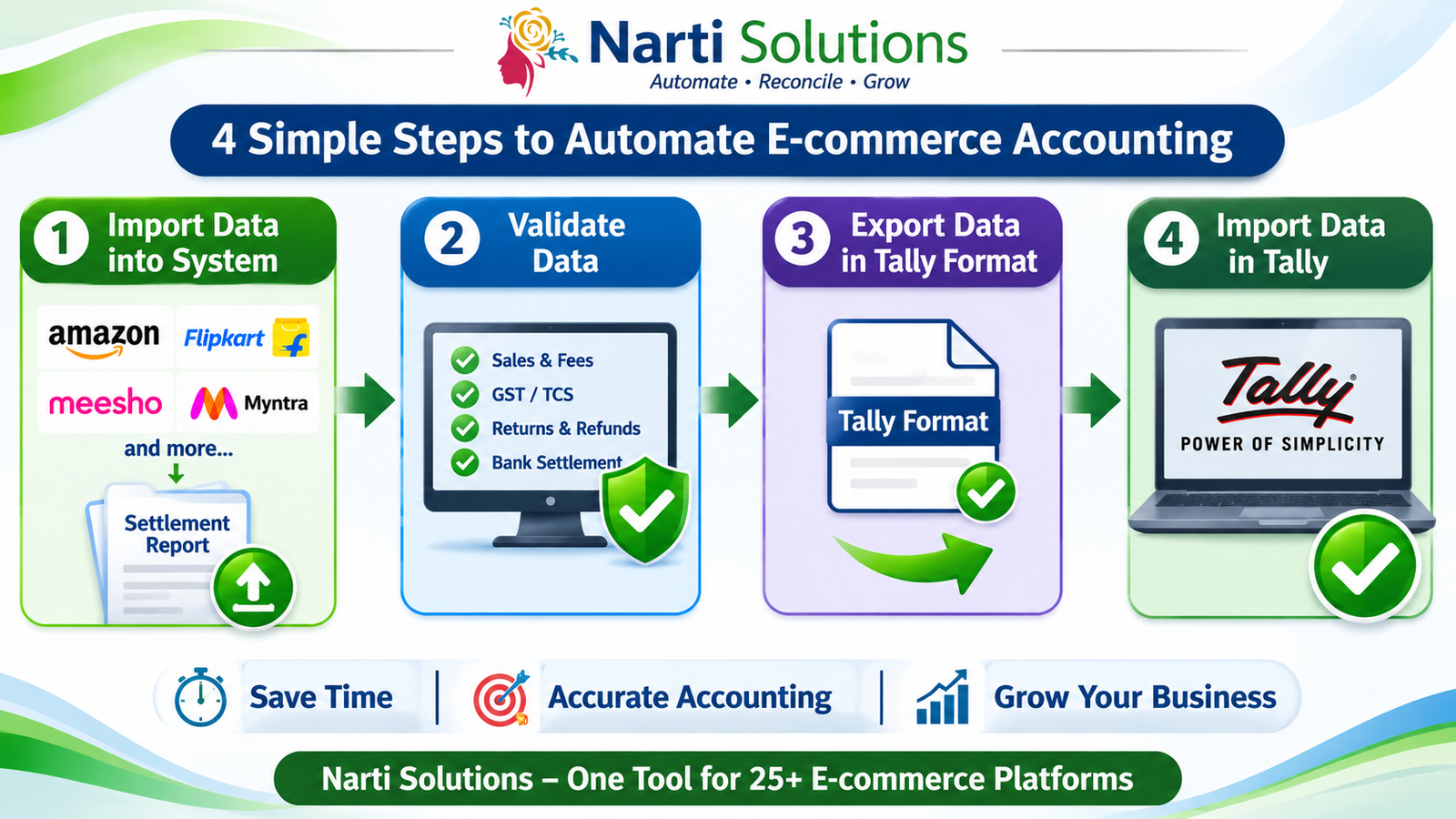
How the Narti Solutions Workflow Works: 4 Simple Steps
The objective is straightforward: import marketplace data, validate it, generate Tally-compatible entries and record the transactions in Tally.
Step 1: Import the marketplace report
Download the relevant settlement, sales, fee, return or other supported reports from the marketplace.
Open the Narti Solutions application and select the appropriate marketplace and report configuration.
Import the file into the tool. The application processes the available data according to the selected platform and report type.
Step 2: Check and validate the values
Review the processed information before generating accounting entries.
- Order and transaction identification.
- Sales and taxable values.
- Marketplace commission and fees.
- GST on applicable charges.
- TCS and TDS deductions.
- Returns, refunds and cancellations.
- Settlement totals and differences.
The objective is to identify missing or inconsistent information before it reaches the accounting books.
This validation stage is important. If a marketplace changes its report format or introduces a new transaction type, the tool should be able to identify unsupported data rather than silently generating incorrect vouchers.
Step 3: Export in Tally-compatible format
Once the data is checked, generate the accounting output in the supported Tally import format.
Depending on the configuration, the output may include:
- Sales vouchers.
- Credit notes.
- Expense or purchase-related entries.
- Bank or settlement entries.
- Marketplace fee entries.
- Tax-related ledger postings.
The voucher structure depends on the seller’s accounting policy, ledger mapping and the type of marketplace transaction.
Step 4: Import entries into Tally order by order
Import the generated entries into Tally and verify the resulting vouchers.
Where the selected configuration supports order-level accounting, the transactions can be recorded order by order instead of being represented only by one consolidated settlement entry.
This helps accountants trace the accounting entry back to the relevant marketplace transaction.
What happens when marketplace charges or tax rates change?
Marketplace fees and tax-related rules can change over time. A reliable workflow should use the applicable transaction date, fee structure and configuration rather than assuming the same rates apply throughout the financial year.
- A marketplace may revise its commission structure.
- A fulfilment fee may change based on product weight or dimensions.
- GST rates or tax treatment may change under applicable notifications.
- A new return or reimbursement transaction type may appear.
Narti Solutions’ configuration and validation process should be checked against these changes during implementation and periodic updates.
Ready to simplify marketplace accounting?
Stop managing separate workflows for every marketplace. See how one configurable application can process supported marketplace reports and prepare accounting entries for Tally.
Book Your Free DemoGeneric Multi-Marketplace Tools vs. Narti Solutions
Many sellers still depend on custom Excel macro tools to convert marketplace reports into accounting entries.
These tools can work well when report structures remain unchanged. However, marketplace platforms regularly update report headers, transaction descriptions, fee categories and settlement formats.
When a macro expects a fixed column or transaction description, a change in the source report can cause errors, skipped records or incorrect calculations.
Narti Solutions takes a configurable approach, supported by in-house AI-assisted data filtering and validation.
| Evaluation criteria | Generic multi-marketplace tools | Narti Solutions |
|---|---|---|
| Marketplace coverage | May require separate modules or tools. | One application designed for 25+ platform configurations. |
| Fee breakdown | Depends on available report mapping. | Configurable fee classification for supported reports. |
| GST TCS matching | May require manual reconciliation. | Dedicated TCS identification and reconciliation workflow. |
| Income-tax TDS | May be grouped with other deductions. | Separate identification and accounting treatment. |
| Fulfilment handling | May have limited model-specific support. | Platform and fulfilment-specific configurations where supported. |
| Advertising visibility | May require separate expense files. | Separate advertising expense processing where supported. |
| Returns and refunds | May need manual adjustments. | Return and credit-note workflow based on supported source data. |
| Report format changes | Fixed macros may break when columns change. | AI-assisted filtering and configurable processing with validation. |
| Tally output | Depends on integration. | Tally-compatible voucher export. |
| Multiple tools | May need separate subscriptions. | One application for supported marketplace configurations. |
Why fixed Excel macros can become a problem
Consider a custom Excel macro designed to process a marketplace settlement report.
The macro expects a column called Shipping Fee. Later, the marketplace changes the column heading or splits the charge into multiple categories.
The macro may then:
- Fail to find the expected column.
- Skip the new transaction type.
- Assign the amount to an incorrect category.
- Generate a settlement difference.
- Require manual code changes before the next import.
This can become a recurring issue when sellers operate across multiple marketplaces.
Narti Solutions is designed to reduce dependence on fixed column assumptions through configurable data processing and AI-assisted filtering. The important point is that the output must still be validated against the original marketplace report.
Illustrative Case Study: Finding Hidden Marketplace Costs
The following example is illustrative. It demonstrates how marketplace accounting analysis can help a seller; it is not a verified Narti Solutions customer result.
Consider a seller operating on Amazon, Flipkart and Meesho.
The seller processes approximately 10,000 orders every month and uses separate Excel macros to prepare Tally entries.
The problem
The seller’s accounts show strong marketplace sales, but the actual contribution margin is lower than expected.
The finance team finds several challenges:
- Advertising expenses are recorded in separate reports.
- Marketplace fees are grouped into broad expense categories.
- Return adjustments are not consistently matched with original orders.
- Settlement amounts require manual bank reconciliation.
- Different Excel macros are maintained for different marketplaces.
As a result, the business cannot easily calculate the actual cost of selling each product.
What changes with a dedicated accounting workflow?
The seller adopts a unified process to import supported marketplace reports, validate transactions, classify deductions and export accounting entries.
The team can now review:
- Sales by marketplace.
- Marketplace commission and fulfilment expenses.
- Advertising deductions.
- Returns and refunds.
- Tax deductions.
- Settlement and bank differences.
Illustrative monthly financial impact
| Metric | Before detailed reconciliation | After detailed reconciliation |
|---|---|---|
| Monthly orders | 10,000 | 10,000 |
| Marketplace reports | Multiple manual files | Unified processing workflow |
| Advertising visibility | Separate review | Separately classified |
| Fee classification | Broad expense grouping | Detailed categories |
| Return matching | Manual checks | Structured matching workflow |
| Bank settlement review | Manual reconciliation | Settlement-focused reconciliation |
The main benefit is not an assumed increase in sales. It is better visibility into the actual cost of selling, fewer repetitive accounting tasks and a clearer basis for financial decisions.
Buyer’s Guide: What to Check Before Choosing a Tally Integration
Not every marketplace accounting tool handles the same level of complexity. Before purchasing a solution, check whether it supports your actual marketplace reports and accounting requirements.
Technical features to verify
- Supports your required marketplaces.
- Supports the relevant report types and fulfilment models.
- Separates sales, fees, taxes and adjustments.
- Handles returns, refunds and cancellations.
- Supports GST TCS identification and reconciliation.
- Separates income-tax TDS from GST TCS.
- Provides advertising expense visibility where supported.
- Generates Tally-compatible vouchers.
- Supports order-level accounting where required.
- Provides error reports and reconciliation checks.
- Has a process for marketplace report-format changes.
- Provides updates and technical support.
Questions to ask a vendor before buying
1. How many marketplaces do you support?
Ask for the actual supported platform list, not just a general claim of multi-marketplace compatibility.
2. Do you support different fulfilment models?
Confirm whether the solution supports your specific Amazon, Flipkart or other marketplace fulfilment workflows.
3. How do you handle changes in marketplace reports?
Ask whether the tool uses fixed column positions, configurable mapping, automated data filtering or a combination of methods.
4. Can you reconcile TCS and TDS separately?
Ask for a practical demonstration using your own settlement data.
5. Can you process returns and refunds?
Check how the software identifies original orders and generates the corresponding accounting adjustments.
6. Can I generate order-level Tally vouchers?
Confirm whether the output can be generated at the level required by your accounting team.
7. What happens during a major sale event?
Ask the vendor:
- Can the tool process increased report volumes?
- Are there file-size or record-count limits?
- Can multiple settlement files be processed?
- What happens if processing fails midway?
- Is there an error log or recovery process?
- Is additional support available during peak events?
8. How secure is my marketplace data?
Ask how uploaded files are stored, who can access them, how long they are retained and whether any API credentials are encrypted.
9. Can I test the software with my actual reports?
A demo using sample data is useful, but a test with your own settlement reports is a better way to verify compatibility.
Frequently Asked Questions
1. What is an e-commerce accounting plugin for Tally?
It is a software integration that converts marketplace sales, settlement, fee, tax and adjustment reports into structured accounting entries for Tally. It helps reduce manual voucher preparation and supports marketplace reconciliation.
2. Does Narti Solutions support multiple marketplaces through one tool?
Yes. Narti Solutions is designed to provide configurations for 25+ e-commerce platforms through one application. The exact supported marketplaces, report types and fulfilment workflows should be confirmed before onboarding.
3. Does the plugin use APIs or uploaded settlement files?
The workflow can use supported marketplace report files. API connectivity depends on the platform and integration available. During the demo, confirm which platforms support API-based retrieval and which require manual report downloads.
4. How does the plugin handle returns, refunds and different fulfilment models?
It processes the available transaction and adjustment data according to the relevant marketplace configuration. Returns, refunds and fulfilment charges should be matched with their corresponding source records wherever the report data allows. The generated vouchers should be reviewed before final import.
5. Is my marketplace data secure?
Before onboarding, review the application’s data-storage, access-control, credential-handling and retention practices. Use authorized marketplace access only, protect API credentials and restrict access to accounting exports. Ask the Narti Solutions team to explain its current security and data-handling arrangements during the demo.
Why Narti Solutions Is a Strong Choice for Multi-Platform Sellers
Managing accounting for one marketplace is already complicated. Managing five or ten marketplaces with different report formats can become a major operational burden.
Narti Solutions aims to simplify this process by offering multiple marketplace configurations through one application rather than requiring a separate accounting tool for every platform.
| Capability | Narti Solutions approach |
|---|---|
| Marketplace configurations | 25+ platform configurations, subject to supported workflows. |
| Application model | One unified application. |
| Data processing | AI-assisted data filtering and validation. |
| Accounting output | Tally-compatible export. |
| Settlement processing | Fee, tax and adjustment classification for supported reports. |
Suitable for different types of e-commerce businesses
Marketplace sellers: Manage accounting across multiple sales channels without maintaining separate conversion tools.
Accountants and bookkeepers: Process client marketplace reports through a more consistent accounting workflow.
CA firms and accounting agencies: Standardise report processing for clients using different marketplaces.
Growing e-commerce businesses: Build an accounting process that can accommodate additional platforms and higher transaction volumes.
If you are currently using multiple Excel macros or separate marketplace accounting tools, compare the time, maintenance and reconciliation effort involved with a unified solution.
Conclusion: Simplify E-commerce Accounting with Narti Solutions
Marketplace accounting should not become more complicated every time your business adds a new sales channel.
A reliable E-commerce Accounting Plugin for Tally should handle more than sales imports. It should help process marketplace fees, fulfilment charges, advertising expenses, returns, refunds, GST TCS, income-tax TDS and settlement adjustments.
Narti Solutions brings multiple marketplace configurations into one application, supported by AI-assisted data filtering, validation workflows and Tally-compatible exports.
Instead of maintaining separate tools for Amazon, Flipkart, Meesho and other supported platforms, sellers can explore one unified accounting workflow.
Ready to simplify your e-commerce accounting?
Book a free demo with Narti Solutions and test the workflow with your own marketplace settlement reports.
Book Your Free Demo Now