
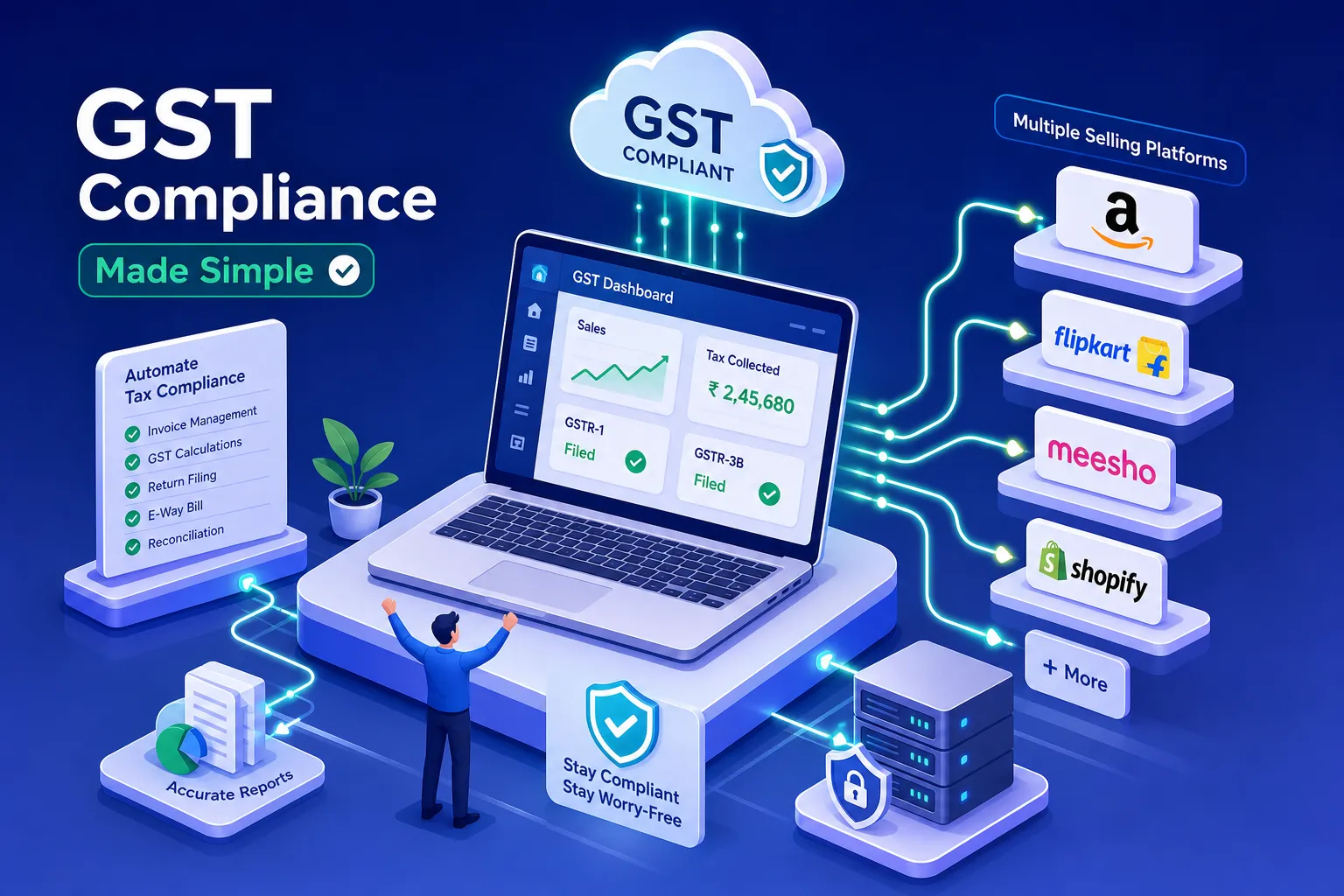
The best software for GST compliance on multiple online selling platforms is not the one with the longest feature list. It is the one that understands how Amazon, Flipkart, and Meesho actually report data to you. For most Indian multi-channel sellers, purpose-built platforms like Narti Solutions are designed to handle marketplace TCS reconciliation, GSTR workflows, and accounting exports natively, in a way generic tools cannot replicate without significant manual effort. Enterprise platforms like ClearTax GST and GSTHero serve high-volume B2B filers well; accounting software like TallyPrime and Zoho Books handles books competently. Many mainstream GST suites and accounting tools, however, were not built around the settlement cycle of a marketplace seller.
The challenge for multi-channel sellers is not simply filing returns. It is reconciling what each marketplace says it paid you, what it withheld as TCS or TDS, what the GST portal actually shows as your credit, and what your bank account received, across five or more platforms, every single month. A tool that handles this correctly saves you hours and protects you from notices; one that does not creates audit risk that manual spreadsheets cannot adequately control either.
Key takeaways
- Marketplace-native integrations matter: Software must pull settlement data from Amazon, Flipkart, Meesho, and other platforms natively, not simply accept CSV uploads.
- TCS and TDS are separate trails: GST TCS under Section 52 and income-tax TDS under Section 194-O must be reconciled independently against different government records.
- E-invoicing thresholds apply in 2026: Sellers above ₹5 crore aggregate turnover must generate IRN-backed e-invoices; those above ₹10 crore must report to the IRP within 30 days.
- Purpose-built tools outperform generic ones: Platforms built specifically for Indian marketplace structures handle settlement reconciliation in ways that accounting software and enterprise GST suites cannot replicate out of the box.
- ROI is measurable: Vendor-published case studies indicate monthly compliance effort can drop substantially after adopting automated reconciliation tools, though figures vary by business size and structure.
- Staged rollout reduces disruption: Connecting one marketplace at a time and validating historical data before going live protects your active operations throughout the transition.
What features must GST compliance software actually cover for multi-channel marketplace selling?
Not every feature on a pricing page matters equally for a multi-marketplace seller. Three capabilities are non-negotiable: data aggregation from each platform, compliant GST document generation, and filing-ready return preparation. If the software cannot handle all three without manual intervention, you will spend your savings bridging the gaps yourself.
Multi-platform data aggregation and marketplace-native settlement imports
Pulling raw settlement reports from Amazon, Flipkart, Meesho, Myntra, and Shopify requires more than a CSV upload. Marketplace-native integration means the software maps each platform’s unique fee codes, return cycles, and settlement batches. The tool needs to understand what an Amazon FBA fulfilment fee is and treat it differently from a Meesho logistics adjustment. It must recognise gross order value separately from net payout, and handle commission deductions, logistics fees, and GST on those fees as distinct line items. Without this mapping, your reconciliation starts with errors already baked in.
E-invoicing thresholds, e-way bill rules, and GSTR filing obligations in 2026
Sellers above ₹5 crore aggregate turnover must generate IRN-backed e-invoices for eligible B2B and export documents; those above ₹10 crore must report to the IRP within 30 days of the document date. E-way bills are required for consignments exceeding ₹50,000, subject to state-level variations. For monthly filers, GSTR-1 is due by the 11th and GSTR-3B by the 20th of the following month; the QRMP scheme is available for sellers up to ₹5 crore. Good GST compliance software for multi-channel sellers automates these triggers based on your actual turnover band, rather than leaving you to monitor thresholds manually every filing cycle.
Audit trail, multi-GSTIN support, and accounting exports
Multi-channel sellers operating across states frequently hold multiple GST registrations. The software must maintain a full audit trail from raw marketplace file through to reconciliation status, and allow separate GSTIN workspaces or consolidated dashboards across entities. Exports into Tally, Busy, or Zoho Books that eliminate manual re-entry are not a convenience feature; they are a data integrity control that protects you during a GST audit.
How do Indian marketplaces report TCS and TDS, and why does that change what software you need?
Indian marketplaces create two separate tax trails for every seller: one under GST and one under the Income Tax Act. These trails operate independently, report on different cycles, and must be reconciled against completely different government records. Software that conflates them, or handles only one, leaves a compliance gap that typically surfaces only when a notice arrives.
The GSTR-8 trail, GST TCS credit, and what the seller must match
The marketplace files GSTR-8 by the 10th of the following month, reporting each seller’s GSTIN, taxable supplies, returns, and TCS collected. The current rate is 0.5% of net taxable supplies: 0.25% CGST plus 0.25% SGST for intra-State transactions, or 0.5% IGST for inter-State supplies. That credit flows into the seller’s electronic cash ledger on the GST portal. The seller must then match settlement-level TCS data from the marketplace statement against the GSTR-8 amount and against what appears in the portal. This three-way reconciliation changes every single month. Software must handle CGST/SGST and IGST components separately, not as one undifferentiated figure.
Section 194-O TDS, Form 26AS reconciliation, and why the two trails must never be netted
Section 194-O requires the marketplace operator to deduct income-tax TDS from the seller’s payout and report it quarterly; the credit appears in Form 26AS and AIS by PAN. This is a receivable, not an expense, and it must be reconciled completely independently of GST TCS. Netting GST TCS and income-tax TDS together is a well-documented compliance error for marketplace sellers that can result in both overpayment and understated tax credits. A capable seller tax compliance platform must match settlement-level TDS to the operator’s TDS certificate and then to 26AS, period by period, with timing-difference handling for credits that appear in a later quarter.
Choosing the best GST compliance software for multiple online selling platforms: how the leading tools compare
The tools in this category fall into three broad groups: marketplace-native reconciliation platforms, enterprise GST compliance suites, and general-purpose accounting software with GST features. Each group serves a different use case, and the gaps between them matter more than the surface-level similarities.
| Tool | Marketplace integrations | TCS/TDS reconciliation | E-invoicing | GSTR-1/3B auto-prep | Multi-GSTIN | Accounting export | Best suited for |
|---|---|---|---|---|---|---|---|
| Narti Solutions | Amazon, Flipkart, Meesho, Myntra, AJIO, Shopify, JioMart and others (vendor-claimed: 25+ platforms) | Vendor-claimed native three-way match with GST portal and 26AS | Yes | Yes | Yes | Tally, Busy, Zoho Books (vendor-claimed one-click export) | Multi-marketplace Indian sellers needing settlement-level reconciliation and GST compliance |
| ClearTax GST | ERP-led; report imports (verify current API options with vendor) | Advanced 2A/2B reconciliation; settlement-native capability varies by plan | Yes | Yes, end-to-end | Yes | Custom ERP | High-volume B2B filers, CA firms |
| GSTHero | Report imports (verify current API options with vendor) | Advanced reconciliation | Yes | Broad return lifecycle | Yes | Custom | Enterprises, CA firms |
| TallyPrime | Limited; manual file import | Books-to-portal reconciliation | Yes | Preparation and upload | Multiple companies | Native | Sellers already in Tally ecosystem |
| Zoho Books | Shopify native; others via CSV | GSTR-2B reconciliation | Eligible plans | Preparation and filing | Multi-GSTIN | Zoho ecosystem | D2C brands with simpler structures |
| BUSY | Manual import | Detailed 2A/2B/3B | Bulk generation | GSTR-1/IFF upload | Branch/GSTIN support | Native | SMB manufacturers and distributors |
Where Narti Solutions fits, and why marketplace-native matters
Many accounting tools and enterprise GST suites were not built around the settlement cycle of Amazon or Flipkart Shopify. Narti Solutions was built by people who ran an eCommerce business across multiple platforms and reconciled those settlements manually before writing software to automate the process. According to the vendor, the product maps settlement batches to SKU-level transactions, routes marketplace TCS into the correct GST clearing account, and delivers data to Tally or Busy already formatted for posting. The vendor also states that Narti Solutions is listed as a service provider on Amazon Seller Central’s Service Provider Network and Flipkart Seller Hub Partner Services, which would allow onboarding from within the dashboards sellers use daily, confirm current status directly with Narti Solutions before onboarding.
What does GST compliance software cost for a multi-marketplace seller, and is the ROI real?
Pricing across this category ranges from a few hundred rupees a month for basic invoicing tools to custom enterprise contracts. The right comparison is not which tool is cheapest. It is which tool eliminates the most manual work per rupee spent, given your specific marketplace mix and transaction volume.
Pricing tiers across the three tool categories
SMB invoicing tools start from roughly ₹300 to ₹900 per month. Mid-market platforms like TallyPrime and Zoho Books use transparent annual licence or subscription pricing, generally in the ₹8,000 to ₹15,000 per year range, scaling with users, GSTINs, and add-ons. Marketplace-native and enterprise platforms such as Narti Solutions, ClearTax GST, and GSTHero use custom pricing based on the number of platforms connected, monthly order volume, GSTINs, and filing scope. The cost gap between tiers is rarely the largest variable in the ROI calculation; the hours saved on manual reconciliation typically are.
Time savings and error reduction: what the published data shows
Vendor-published case studies for automated reconciliation tools report results including mismatch variance falling from 21% to under 1.8%, filing delays declining 48%, and zero GST notices over a review period. A separate implementation report cited monthly compliance effort dropping from 250 hours to 40 hours, with a 384% ROI on the technology cost, figures sourced from the implementation firm’s own reporting and not independently audited. These should be treated as directional rather than guaranteed outcomes. That said, the pattern across multiple published examples is consistent: hours saved on settlement-to-return reconciliation routinely exceed the software cost within the first quarter of implementation, making GST filing tools for marketplaces a strong candidate for early evaluation.
How do you roll out a GST compliance tool across live marketplace accounts without disrupting operations?
Most sellers delay switching tools because they fear disrupting a live business. A staged rollout, connected to your actual settlement cycle, avoids that disruption and gives you a validation window before your first live filing on the new platform. Three phases cover the transition without touching anything you cannot reverse.
Phase 1: connect data sources and validate historical settlement data
Start by connecting one marketplace at a time, beginning with your highest-volume platform. Import the last three months of settlement reports and run the tool’s reconciliation against the GST amounts you have already filed. The gap between what the tool calculates and what you previously reported is your baseline accuracy measure. When evaluating multi-platform GST reconciliation tools, ask vendors specifically about onboarding support to configure marketplace connections, map fee codes, and surface historical mismatches before a single live transaction is processed.
Phase 2: configure GST workflows, e-invoicing triggers, and accounting exports
Once data flows cleanly from each marketplace, configure your e-invoicing threshold trigger if you are above ₹5 crore, set up HSN-level tax calculations, and test the accounting export against a sample period in Tally or Busy. The goal is to confirm that the chart of accounts in the compliance tool matches your books before any live transaction is exported. Most implementation issues surface here: mismatched account codes, missing GSTIN mappings, or platform-specific fee categories that require custom rules to classify correctly.
Phase 3: go live with GSTR-1 preparation and monthly reconciliation cycles
Run the first live GSTR-1 preparation cycle in parallel with your previous method, compare the outputs, and resolve discrepancies before filing. From the second month onward, the tool handles GSTR-1 preparation, TCS matching against the GSTR-8 portal credit, and accounting exports with minimal manual input. Set a monthly review checkpoint on or before the 10th to catch software-flagged exceptions ahead of the filing deadline.
Choosing the right GST compliance software for multiple online selling platforms
For most Indian multi-channel sellers, the core decision is not between good tools and bad ones. It is between tools built for marketplace settlement structures and tools that require you to bridge the gap manually. If your business runs across Amazon, Flipkart, Meesho, or Shopify and your bookkeeper is still spending days each month translating settlement reports into GST-compliant records, the software is not doing its job.
The best software for GST compliance on multiple online selling platforms is one that handles settlement-native reconciliation, marketplace TCS workflows, and direct exports into the accounting software Indian sellers actually use. Narti Solutions is built specifically for this structure. Enterprise suites like ClearTax GST or GSTHero serve complex B2B filing needs at scale. General accounting tools handle books competently but not the marketplace layer between the sale and the books. Use the features checklist in the first section, the comparison table above, and the staged rollout plan to shortlist and validate your choice before the next filing cycle.
A note from Narti Solutions: If you want to see how Narti Solutions handles your specific marketplace mix, contact the Narti Solutions team for a personalised walkthrough. The team will map your settlement structure, identify your reconciliation gaps, and show you what compliant, automated reporting looks like before you commit to anything.
Frequently Asked Questions
Will adopting a marketplace-native GST tool reduce the risk of GST notices?
Yes, a tool that handles settlement-native reconciliation and marketplace TCS workflows can reduce the risk of GST notices. Vendor-published case studies report outcomes including zero GST notices over a review period and large reductions in mismatch variance and filing delays, though these figures are directional rather than guaranteed.
Can TallyPrime or Zoho Books alone manage marketplace TCS and TDS reconciliation for multi-channel sellers?
No, general accounting software like TallyPrime and Zoho Books handles books competently but typically does not manage the marketplace settlement layer natively. Those tools often require manual imports or bridging work to map marketplace fee codes, settlement batches and separate TCS/TDS trails, which reintroduces manual effort and audit risk.
Do I need to reconcile GST TCS and income-tax TDS separately?
Yes, GST TCS under Section 52 and income-tax TDS under Section 194-O must be reconciled independently against different government records. The marketplace files GSTR-8 reporting TCS while TDS appears on Form 26AS and AIS by PAN, and netting the two is a common compliance error.
Can I onboard Narti Solutions from within Amazon Seller Central or Flipkart Seller Hub?
Possibly, the vendor states Narti Solutions is listed as a service provider on Amazon Seller Central’s Service Provider Network and Flipkart Seller Hub Partner Services, which would allow onboarding from within those dashboards. Confirm the current status directly with Narti Solutions before beginning onboarding to ensure that in-dashboard onboarding is available for your account.